Connect with us

Pakistan

NA deputy speaker accepts resignations of PTI’s 123 MNAs

Published

on

  • Taking to Twitter, former prime minister Imran Khan lauds his MNAs for resigning from the National Assembly.
  • Says MNAs are “standing firm for a sovereign Pak & against US-initiated regime change bringing to power criminals, convicted & on bail.”
  • Says regime change is the ultimate insult to any self-respecting independent nation.

The Deputy Speaker of National Assembly Qasim Suri on Thursday accepted the resignations of 123 PTI MNAs after they decided to disassociate themselves from the National Assembly following the ouster of PTI Chairman Imran Khan from the office of the prime minister.

Khan was ousted through a no-confidence motion brought against him by the then joint Opposition, a move that the PTI called a “foreign conspiracy” hatched by the United States. The allegation, however, has been categorically denied by the superpower. 

After being removed from the office, the former premier asked his MNAs to tender their resignations and refused to accept the newly elected premier, saying “there can’t be any bigger insult to this country”.

Taking to Twitter Thursday, Imran Khan lauded his MNAs for tendering their resignations.

“Want to appreciate our 123 MNAs as their resignations have been accepted by Speaker Qasim Suri. Their standing firm for a sovereign Pak & against US-initiated regime change bringing to power criminals, convicted & on bail — the ultimate insult to any self-respecting indep[endent] nation.”

Responding to the call of the former prime minister, PTI’s MNAs tendered their resignations to the deputy speaker of the National Assembly hours before the election of Shehbaz Sharif as the new prime minister. 

The decision was reportedly made during the PTI’s parliamentary party meeting on April 11.

Sources privy to the matter quoted Khan as saying: “We will not sit in this Assembly under any circumstances.” 

He said that PTI will not sit in the Assembly with the “people who have robbed Pakistan” and who have been “imported by foreign forces”.

“We have made this decision to keep the institutions under pressure who want this government to run the country […] we will not let them continue.”

It is worth mentioning that the Election Commission of Pakistan (ECP) can hold the by-elections at any given point and it is not bound by any time limit.

MNAs who did not resign

Meanwhile, some of the MNAs who have not resigned from the assembly include Farrukh Altaf, Amir Sultan Cheema, Afzal Dhandla, Ghulam Muhammad Lali, Asim Nazir, Nawab Sher Wasir, Riaz Fatyana, Ghulam Bibi Bharwana, Ahmed Hussain Deharr, Rai Murtaza Iqbal, Qasim Noon, Ghaffar Wattoo, Samiul Hassan Gilani, Makhdoom Mubeen, Basit Sultan Bukhari, Aamir Talal Gopang, Amjad Farooq Khosa, Sardar Jafar Leghari,  Javaria Zafar Aheer, Sardar Riaz Mazari, and Wajiha Akram.

Imran Khan ousted from power

On Saturday, April 10, Imran Khan was ousted as the prime minister of Pakistan from office through a no-confidence motion.

The session was chaired by Ayaz Sadiq — a member of the panel of chairs — after speaker Asad Qasier resigned from his post.

“174 members have recorded their votes in favour of the resolution, consequently the resolution for the vote on no-confidence against Mr Imran Khan, the prime minister of Pakistan, has been passed by a majority,” Ayaz Sadiq announced after the process of voting was completed.

Once the voting was concluded and the result was announced, Opposition leaders delivered their victory speeches. The session then was adjourned till 11am on Monday, April 11.

Business

Supreme Court annuls trials of civilians in military courts

Published

on

By

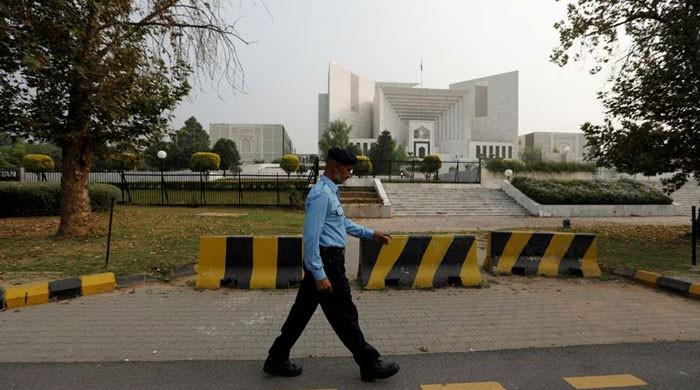
In a unanimous verdict, a five-member bench of the Supreme Court on Monday declared civilians’ trials in military courts null and void as it admitted the petitions challenging the trial of civilians involved in the May 9 riots triggered by the arrest of Pakistan Tehreek-e-Insaf (PTI) chief Imran Khan in a corruption case.

The five-member apex court bench — headed by Justice Ijaz Ul Ahsan, and comprising Justice Munib Akhtar, Justice Yahya Afridi, Justice Sayyed Mazahar Ali Akbar Naqvi and Justice Ayesha Malik — heard the petitions filed by the PTI chief and others on Monday.

The larger bench in its short verdict ordered that 102 accused arrested under the Army Act be tried in the criminal court and ruled that the trial of any civilian if held in military court has been declared null and void.  

The apex court had reserved the verdict earlier today after Attorney General of Pakistan (AGP) Mansoor Usman Awan completed his arguments centred around the domain and scope of the military courts to try the civilians under the Army Act. 

At the outset of the hearing today, petitioner lawyer Salman Akram Raja told the bench that trials of civilians already commenced before the top court’s verdict in the matter.

Responding to this, Justice Ahsan said the method of conducting proceedings of the case would be settled after Attorney General of Pakistan (AGP) Mansoor Usman Awan completed his arguments.

Presenting his arguments, the AGP said he would explain to the court why a constitutional amendment was necessary to form military courts in 2015 to try the terrorists.

Responding to Justice Ahsan’s query, AGP Awan said the accused who were tried in military courts were local as well as foreign nationals.

He said the accused would be tried under Section 2 (1) (D) of the Official Secrets Act and a trial under the Army Act would fulfill all the requirements of a criminal case.

“The trial of the May 9 accused will be held in line with the procedure of a criminal court,” the AGP said.

The AGP said the 21st Amendment was passed because the terrorists did not fall in the ambit of the Army Act.

“Amendment was necessary for the trial of terrorists [then] why amendment not required for the civilians? At the time of the 21st constitutional amendment, did the accused attack the army or installations?” inquired Justice Ahsan.

AGP Awan replied that the 21st Amendment included a provision to try accused involved in attacking restricted areas.

“How do civilians come under the ambit of the Army Act?” Justice Ahsan asked the AGP.

Justice Malik asked AGP Awan to explain what does Article 8 of the Constitution say. “According to Article 8, legislation against fundamental rights cannot be sustained,” the AGP responded.

Justice Malik observed that the Army Act was enacted to establish discipline in the forces. “How can the law of discipline in the armed forces be applied to civilians?” she inquired.

The AGP responded by saying that discipline of the forces is an internal matter while obstructing armed forces from discharging duties is a separate issue.

He said any person facing the charges under the Army Act can be tried in military courts.

“The laws you [AGP] are referring to are related to army discipline,” Justice Ahsan said.

Justice Malik inquired whether the provision of fundamental rights be left to the will of Parliament.

“The Constitution ensures the provision of fundamental rights at all costs,” she added.

If the court opened this door then even a traffic signal violator will be deprived of his fundamental rights, Justice Malik said.

The AGP told the bench that court-martial is not an established court under Article 175 of the Constitution.

At which, Justice Ahsan said court martials are not under Article 175 but are courts established under the Constitution and Law.

After hearing the arguments, the bench reserved the verdict on the petitions.

A day earlier, the federal government informed the apex court that the military trials of civilians had already commenced.

After concluding the hearing, Justice Ahsan hinted at issuing a short order on the petitions. 

The government told the court about the development related to trials in the military court in a miscellaneous application following orders of the top court on August 3, highlighting that at least 102 people were taken into custody due to their involvement in the attacks on military installations and establishments. 

Suspects express confidence in mly courts

The same day, expressing their “faith and confidence” in military authorities, nine of the May 9 suspects — who are currently in army’s custody — moved the Supreme Court, seeking an order for their trial in the military court be proceeded and concluded expeditiously to “meet the ends of justice”.

Nine out of more than 100 suspects, who were in the army’s custody, filed their petitions in the apex court via an advocate-on-record.

The May 9 riots were triggered almost across the country after former prime minister Imran Khan’s — who was removed from office via a vote of no confidence in April last year — arrest in the £190 million settlement case. Hundreds of PTI workers and senior leaders were put behind bars for their involvement in violence and attacks on military installations.

Last hearing

In response to the move by the then-government and military to try the May 9 protestors in military courts, PTI Chairman Imran Khan, former chief justice Jawwad S Khawaja, lawyer Aitzaz Ahsan, and five civil society members, including Pakistan Institute of Labour Education and Research (Piler) Executive Director Karamat Ali, requested the apex court to declare the military trials “unconstitutional”.

The initial hearings were marred by objections on the bench formation and recusals by the judges. Eventually, the six-member bench heard the petitions.

However, in the last hearing on August 3, the then-chief justice Umar Ata Bandial said the apex court would stop the country’s army from resorting to any unconstitutional moves while hearing the pleas challenging the trial of civilians in military courts.

A six-member bench, led by the CJP and comprising Justice Ijaz Ul Ahsan, Justice Munib Akhtar, Justice Yahya Afridi, Justice Sayyed Mazahar Ali Akbar Naqvi, and Justice Ayesha Malik, heard the case.

In the last hearing, the case was adjourned indefinitely after the Attorney General for Pakistan (AGP) Mansoor Usman Awan assured the then CJP that the military trials would not proceed without informing the apex court.

Continue Reading

Pakistan

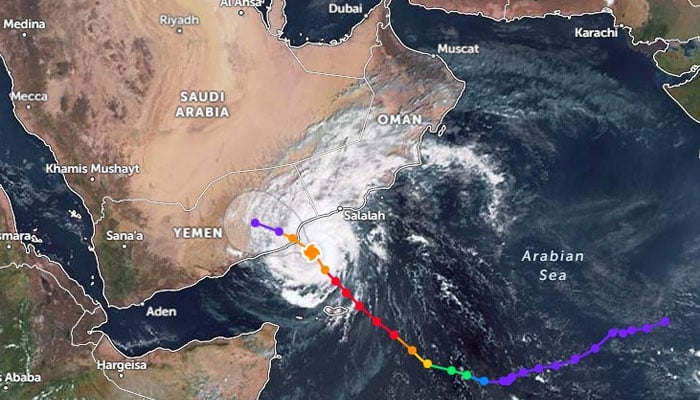
Sea conditions ‘very high’ as Cyclone Tej moves towards northwestward

Published

on

By

An Extremely Severe Cyclonic Storm (ESCS) named “Tej”, which has been brewing in the southwest Arabian Sea for the past few days, has continued to move northwestward toward the Arabian Peninsula’s coast.

According to the Pakistan Meteorological Department (PMD), over the past 12 hours, Cyclone Tej has been moving in a northwestward direction and is now “centred around latitude 14.4 N & longitude 53.2 °E”.

The update, which was issued today (Monday) at 10:00am (PST), also revealed that the brewing cyclone is situated “about 300km southwest of Salalah (Oman), 220km southeast of Al Ghaydah (Yemen) and 1520km southwest of Gwadar (Pakistan)”.

Additionally, the cyclone’s maximum sustained surface winds are between 150-160km/h, with gusts reaching 180km/h.

Moreover, sea conditions are currently very high, with maximum wave heights of 35ft around the system centre, according to the Met Office.

The system is expected to continue moving in a northwest direction and is likely to cross the Yemen coast, near Al Ghaydah by midnight as a very severe cyclonic storm (VSCS) with winds packing speeds of 120-130km/h and gusts reaching 150km/h.

However, it is important to note that there will be no impact on any of Pakistan’s coastal areas from this system.

According to PMD’s Daily Forecast, the weather is expected to remain dry for the next few days in most districts of Sindh, one of the coastal provinces of Pakistan.

Meanwhile, strong winds and thundershowers are likely to occur in and around some parts of Balochistan today, but dry weather is expected for the next few days.

Continue Reading

Pakistan

Pakistan sending essential medical supplies to Gaza today: FO

Published

on

By

  • Pakistan remains deeply concerned about situation in Gaza: FO.
  • “We strongly condemn Israeli aggression, blockade,” says spox.
  • Israel agrees on deal to allow goods cross Rafah crossing into Gaza.

Amid the worsening humanitarian situation in Gaza, Pakistan is sending assistance for Palestinians reeling from Israel’s relentless bombing.

“A chartered aircraft carrying 100 tonnes of essential medical supplies, tents, and blankets will depart from Islamabad for Egypt this afternoon. From Egypt, these items will be transferred to the people of Gaza,” Foreign Office Spokesperson Mumtaz Zahra Baloch said at a weekly press briefing on Thursday.

Israel’s unabated airstrikes on Gaza have claimed nearly 3,500 lives while thousands of others are injured. Entire city blocks have been levelled, water, food and power have been cut off, and over one million people have been displaced.

Hamas’s October 7 attack on Israel has claimed more than 1,400 lives — and the conflict has set off a wave of fury across the Middle East against Israel and its Western allies.

At the media briefing today, the FO spokesperson said Pakistan remains deeply concerned about the situation of “our Palestinian brothers and sisters” in Gaza.

“We strongly condemn the Israeli aggression and blockade, particularly the recent attack on a Gaza hospital. Israel’s actions violate international humanitarian and human rights law,” she added.

The FO spokesperson further said deliberate attacks against civilian targets constitute war crimes and crimes against humanity. “We call for an immediate ceasefire; an end to the siege of Gaza; and the facilitation of humanitarian corridors for unrestricted relief supplies.”

The development came as Israel agreed on a deal for an initial 20 trucks carrying relief goods to cross the shuttered Rafah crossing from Egypt into Gaza, with the first deliveries expected Friday at the earliest.

More than 100 trucks carrying aid goods have been queued for days on the Egyptian side of the Rafah border crossing, the only entry or exit point to Gaza not controlled by Israel.

Cairo has so far kept it closed, pointing to repeated Israeli strikes near the crossing and voicing fears that Israel may be hoping to permanently drive Palestinians out and into Egypt´s Sinai desert.

On the Gaza side, scores of people were again waiting, desperate to flee, but careful to keep a distance of about 100 metres (300 feet) in case of new Israeli strikes.

There are fears of worse to come if Israel launches its anticipated ground invasion aimed at destroying Hamas and rescuing Israeli and foreign hostages, whose known number Israel on Thursday revised up to 203.

Referring to the urgent Ministerial Meeting of the OIC Executive Committee held in Jeddah yesterday, which was co-convened by Pakistan and Saudi Arabia, Baloch said Foreign Minister Jalil Abbas Jillani stressed that the core issue underlying the conflict was the failure to implement the two-state solution. 

The FM reaffirmed Pakistan’s unwavering support for Palestinian self-determination and advocated for the establishment of a secure, contiguous, and sovereign Palestinian state, she added.

“The Joint Communiqué adopted after yesterday’s meeting reflects the unified stance of the Muslim Ummah on the Gaza situation. Pakistan has been actively engaged in consultation with OIC member states as part of our contribution to developing this consensus,” the FO spokesperson said. 

Continue Reading

Trending