
Latest News
Sri Lanka PM offers resignation after protesters storm president’s house


- Thousands of protesters storm president’s house, office.
- Prime minister says willing to step aside.
- Protesters demand president’s resignation over crisis.
COLOMBO, July 9 (Reuters) – Sri Lanka Prime Minister Ranil Wickremesinghe is willing to resign to make way for an all-party government, his office said in a statement on Saturday, after thousands of protesters stormed the president’s official residence in Colombo.
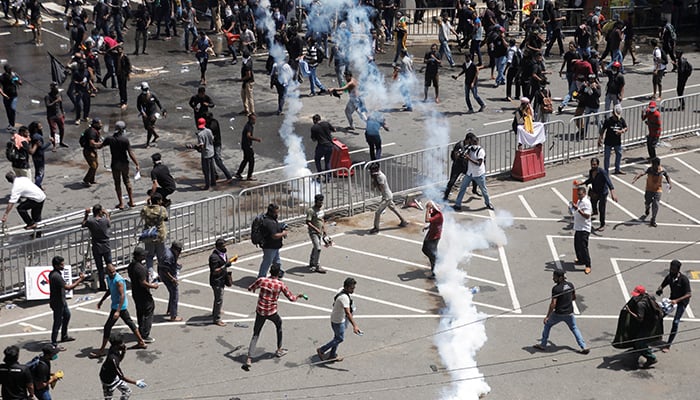
Soldiers and police were unable to hold back the crowd of chanting protesters demanding President Gotabaya Rajapaksa’s resignation, as public anger grows over the country’s worst economic crisis in seven decades.
Protesters also forced their way through heavy metal gates into the Finance Ministry and the president’s seafront offices.
Rajapaksa left the official residence on Friday as a safety precaution ahead of the planned weekend demonstration, two defence ministry sources said. Reuters could not immediately confirm the president’s whereabouts.
Wickremesinghe held talks with several political party leaders to decide what steps to take following the unrest.
“Wickremesinghe has told the party leaders that he is willing to resign as Prime Minister and make way for an all-party government to take over,” his office said in a statement.
Wickremesinghe had also been moved to a secure location, a government source told Reuters.
Leaders of several opposition parties have also called for Rajapaksa to resign.
“The president and the prime minister must resign immediately. If that does not happen political instability will worsen,” said Sri Lanka Freedom Party leader and former president Maithripala Sirisena, speaking before Wickremesinghe had offered his resignation.
Presidential pool
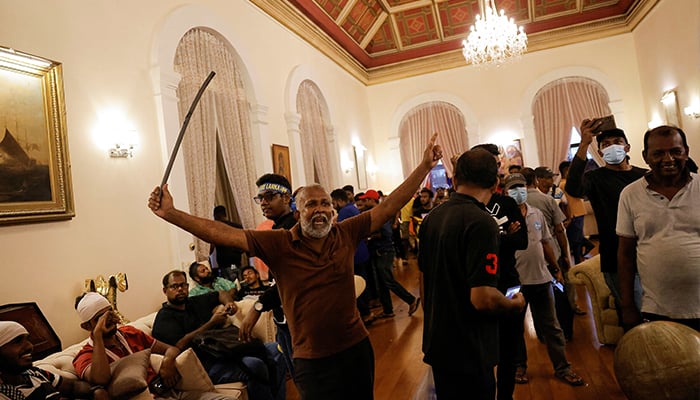
A Facebook live stream from inside the president’s house showed hundreds of protesters, some draped in the national flag, packing into rooms and corridors.
Video footage showed some of them splashing in the swimming pool, while others sat on a four-poster bed and sofas. Some could be seen emptying out a chest of drawers in images that were widely circulated on social media.
Hundreds milled about on the grounds of the colonial-era whitewashed residence, with no security personnel in sight.
At least 39 people, including two police officers, were injured and hospitalised during the protests, hospital sources told Reuters.
The Indian Ocean island of 22 million people is struggling under a severe foreign exchange shortage that has limited essential imports of fuel, food and medicine, plunging it into the worst economic crisis since independence in 1948.
Soaring inflation, which reached a record 54.6% in June and is expected to hit 70% in the coming months, has heaped hardship on the population.
Political instability could undermine Sri Lanka’s talks with the International Monetary Fund as it seeks a $3 billion bailout, the restructuring of some foreign debt and fund-raising from multilateral and bilateral sources to ease the dollar drought.
“This is a dicey situation. If a clear transition is not put in place the president and prime minister’s resignation will create a power vacuum that could be dangerous. The Speaker can appoint a new all-party government but whether they will be accepted by the protesters remains to be seen,” said political analyst Kusal Perera.
Economic crisis
The crisis comes after COVID-19 hammered the tourism-reliant economy and slashed remittances from overseas workers.
It has been compounded by the build-up of hefty government debt, rising oil prices and a ban on the import of chemical fertilisers last year that devastated agriculture. The fertiliser ban was reversed in November.
However, many blame the country’s decline on economic mismanagement by Rajapaksa and there have been months of largely peaceful protests demanding his resignation.
Before breaking into the government buildings on Saturday, the protesters dismantled several police barricades in Colombo’s government district.
Police fired shots in the air but were unable to stop the angry crowd from surrounding the presidential residence, the witness said.
Despite a severe shortage of fuel that has stalled transport services, demonstrators packed into buses, trains and trucks from several parts of the country to reach Colombo for the weekend demonstration.
Discontent has worsened in recent weeks as the cash-strapped country stopped receiving fuel shipments, forcing school closures and rationing of petrol and diesel for essential services.
Sampath Perera, a 37-year-old fisherman, took an overcrowded bus from the seaside town of Negombo 45 km (30 miles) north of Colombo, to join the protest.
“We have told Gota (Rajapaksa) over and over again to go home but he is still clinging on to power. We will not stop until he listens to us,” Perera said.





YouTube’s famous couple Sham Idrees and Froggy aka Sehar are taking sometime away from each other in their relationship.
Sham, taking it to his Instagram, left his fans in a shock after announcing his separation with Froggy. He wrote: “I would like to announce that me and froggy are taking sometime away from each other in our relationship. Please don’t involve me in issues concerning froggy, rabil or any of the other family members. I appreciate some privacy during this difficult time.”
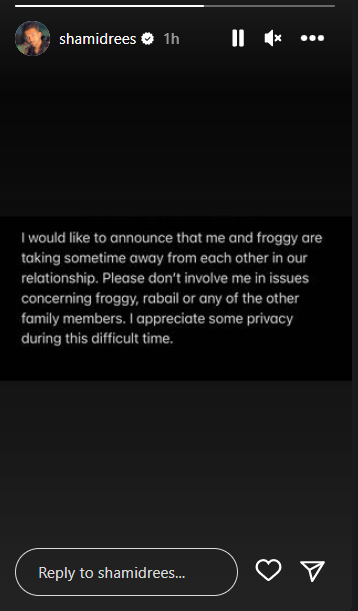
Sham is a Canadian based YouTuber, who has a following of 1.4 million people on Instagram, is widely-known for his entertaining content. His videos often feature his wife Sehar along with him.
The couple tied the knot a few years ago and is parents to baby Sierra who is two-years old. The duo welcomed another daughter on September 28, 2022. They named her Shanaya Idrees.
After the birth of his first daughter, Sham Idrees also introduced his fans to his daughter Dua from his previous marriage.
- Minister says power generation units are temporarily shut in winter at night.
- Says frequency variation in national grid triggered outage.
- Says ministry trying to restore power in next 12 hours.
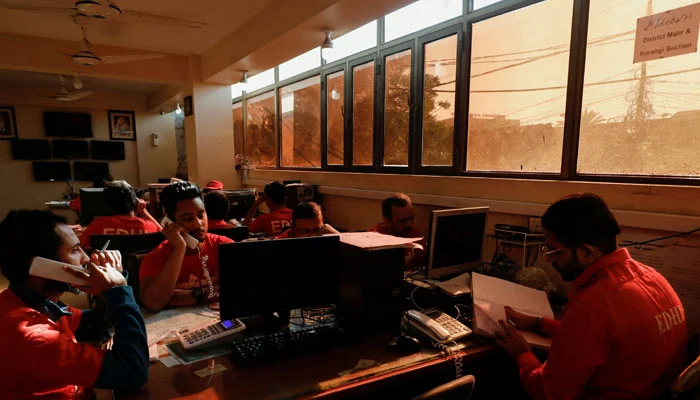
LAHORE/KARACHI/QUETTA/ISLAMABAD: A countrywide power breakdown, triggered by a “frequency variation” in the national grid early Monday morning, has left large parts of the country including Karachi, Lahore, Islamabad, Peshawar and Quetta without electricity.
Power Minister Khurrum Dastagir, while talking to Geo News, said that the power generation units are temporarily shut down in winter at night as an economic measure to save fuel costs.
“When the systems were turned on at 7:30am this morning one by one, frequency variation was reported in the southern part of the country between Jamshoro and Dadu. There was a fluctuation in voltage and power generating units were shut down one by one due to cascading impact. This is not a major crisis,” said the federal minister as the country plunged into darkness for the second time in four months.
The minister said that his ministry has started restoring some grid stations in Tarbela and Warsak.
“Peshawar Electric Supply Company (PESCO) and some grids of Islamabad Electric Supply Company (IESCO) have already been restored,” claimed the minister.
Talking about the breakdown in Karachi, the minister said that the matter in the port city is complicated as it has a complete electric supply system.
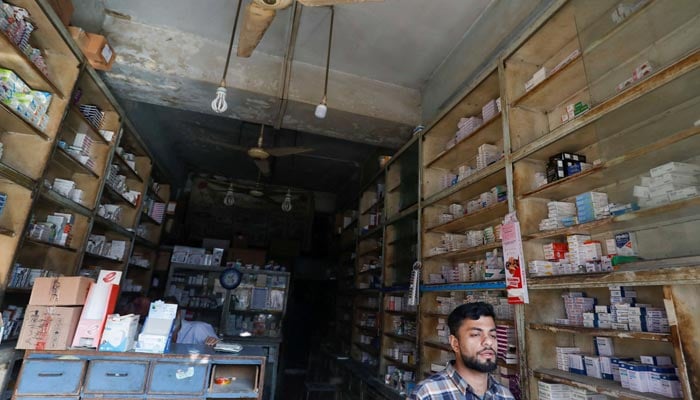
“We provide K-Electric about 1,000-1,100 megawatts routinely, however, it will be restored within a few hours. It is not certain how long will it take to sort this issue. However, my target is to restore electricity in the country in the next 12 hours,” said the minister.
Before the energy ministry’s announcement, different power distribution companies had confirmed the breakdown.
According to Quetta Electric Supply Company (QESCO), the two transmission lines have tripped leaving 22 districts of Balochistan, including Quetta without power.
Karachi power update
Meanwhile, K-Electric spokesperson Imran Rana said that at approximately 7:34am today, the national grid experienced a loss of frequency, affecting the power supply to multiple cities across Pakistan
“This has also cascaded to KE’s network affecting power supply to Karachi,” Rana said, adding the KE’s network is safe and protected.
“Our teams are actively monitoring the situation and enabling restoration efforts.”
An IESCO spokesperson said that its 117 grid stations were without electricity.
Meanwhile, PESCO also confirmed the outage in areas where it supplies electricity.
This is the second time within four months that a country was hit by a major power breakdown.
NEPRA takes notice
The National Electric Power Regulatory Authority (NEPRA), in a statement, said that it has taken “serious notice” of the power outage and directed the National Transmission & Despatch Company (NTDC) to submit a “detailed report”.
The statement also said that the regulator has previously imposed fines on similar outages in the 2021 and 2022. It also shared that NEPRA has consistently issued directives and recommendations on tackling such events in future.
Previous breakdown
In October of last year, Karachi, Hyderabad, Sukkur, Quetta, Multan, and Faisalabad were hit by a power outage.
At that time, the power minister said that nearly 8,000 megawatts of power went offline.
Back then, Dastagir had said that the simultaneous faults in two power lines, which had triggered the breakdown, at the same time was concerning for the government. He had also announced that an in-depth inquiry was ordered and promised action.
A timeline of power breakdowns in Pakistan
The country’s generation and distribution network has suffered eight major power breakdowns during the last nine years.
In 2014 and 2017, nationwide blackouts were caused by a fault in Tarbela Power Station while fog, frequency variation and the Guddu Power Plant fault were blamed for breakdowns in 2015, 2018, 2019, 2021, 2022 and 2023.
Every time the party in power announced to conduct a comprehensive probe and vowed to rectify the issues but nothing has happened despite multiple inquiries.


Supreme Court annuls trials of civilians in military courts

Sea conditions ‘very high’ as Cyclone Tej moves towards northwestward

IMF condition: ECC set to green light gas tariff hike today

Barwaan Khiladi: Kinza Hashmi discusses her role as Alia

Snap launches tools for parents to monitor teens’ contacts

WATCH: Pakistani traveller deported from Dubai for damaging plane mid-air

Learn First | How to Create Amazon Seller Account in Pakistan – Step by Step

Sajjad Jani Funny Mushaira | Funny Poetry On Cars🚗 | Funny Videos | Sajjad Jani Official Team
