
Latest News
Pakistanis prefer to go down with me than supporting ‘three stooges’: PM Imran Khan

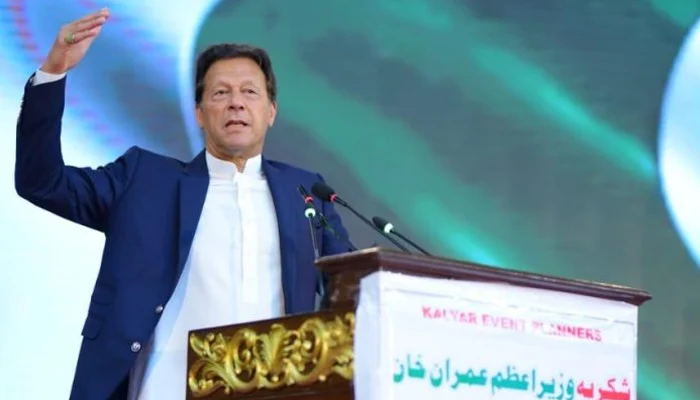
- PM Imran challenges media, economists, Opposition to hold a debate.
- PM dubs Opposition leaders Fazl, Zardari, and Shahbaz “three stooges”.
- He thanks Opposition for helping people forget prices of “tomato, potato”.
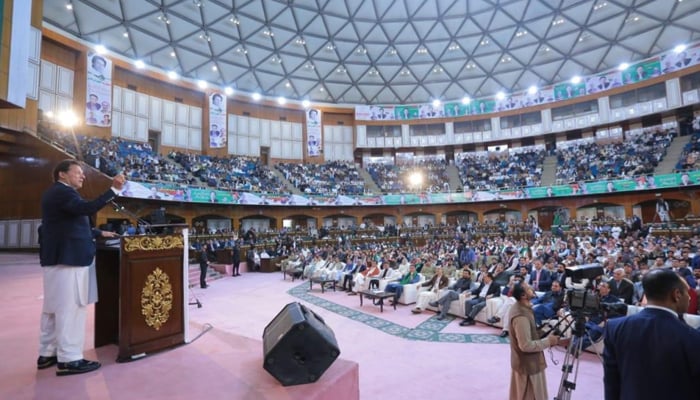
ISLAMABAD: Prime Minister Imran Khan said Tuesday the entire nation was ready to go down with him rather than supporting the “three stooges”, as he slammed the Opposition amid rising political tensions due to the no-confidence motion.
In his address to the overseas convention in Islamabad, the prime minister said: “When the people saw the faces of the three stooges — PML-N President Shahbaz Sharif, Pakistan Democratic Movement (PDM) chief Maulana Fazlur Rehman, and PPP Co-chairman Asif Ali Zardari — they decided against supporting them and expressed their desire to go down with [me].”
The prime minister thanked the Opposition for moving the no-confidence motion as through this, his party had strengthened, with people all-geared up for the March 27 rally — which is expected to take place at D-Chowk just a day before the National Assembly votes on the no-trust motion.
PM Imran Khan also thanked the Opposition “wholeheartedly” as they had made people forget the rates of potatoes and tomatoes.
The premier said he and his team were always trying to figure out ways to reduce the impact of inflation on the masses, but after the Opposition’s no-confidence motion, the focus shifted to mainstream politics rather than inflation.
PM Imran Khan said neither of the three parties — PPP, PML-N, and JUI-F — worked at the grass-root levels and did “actual politics”, while the PTI struggled for more than two decades to get to where it is today. “They cannot defeat us.”
“Nawaz became the chief minister through General Jilani; Shahbaz, who used to give bribes to get his work done, has now become; Zardari became the president by ‘showing’ a fake paper; Fazl has been selling the religion from the last 30 years,” he said.
PM’s predictions on no-trust motion, 2023 elections
PM Imran Khan said the Opposition leaders were under the “false impression that the people had forgotten their corruption”, but they were wrong as now, they had fallen into the “captain’s trap”.
“I predict that not only is their no-confidence motion going to fail, but they will taste defeat in the 2023 general elections as well,” he said, foreseeing his party’s triumph in the polls.
Moving on to praise overseas Pakistanis, he thanked them for supporting the country and sending a record remittance through which the state was running its economic affairs.
“But when overseas Pakistanis, who are working hard abroad, see these corrupt politicians enjoying parties and living in palaces in foreign countries, they are hurt,” he lamented.
PM Imran Khan said due to the corruption of the politicians, the country had become a “slave” to the foreign powers. “When our then prime minister [Nawaz Sharif] met then US president Barack Obama, his legs were shaking as he was cautious against saying something his ‘master’ might feel bad about.”
“Because they know [those countries] can catch their [corrupt Pakistani politicians’] money laundering whenever they want,” the prime minister said.
As a result of having corrupt leaders, the prime minister said that Pakistan faced drone attacks during the tenure of the previous governments — resulting in the loss of lives and capital.
“If we don’t respect ourselves, then the world will not respect us,” the prime minister said, as he shed light on the casualties that Pakistan incurred because of the US “War on Terror”.
‘Not anti-US, UK, and India’
PM Imran Khan said he was against America’s “War on Terror”, the 2003 invasion of Iraq, and the Hindutva mindset that prevailed in India.
“But am I not anti-US, UK, and India […] I pray that a sensible leadership comes into power in India so that we can hold talks with them after revoking the August 5, 2019, decision on Kashmir.”
The prime minister lamented that the Western nations had double standards as they do not allow people to become the judge, jury, and executioners in their homeland.
“But they (Western powers) were bombing on the Pakistani land and killing innocent people […] and they are responsible for this,” he said, lashing out at the previous governments of PPP and PML-N.
Challenge to economists, media, Opposition
Talking about the government’s development and social works, he said that the PTI launched health cards for the underprivileged people — the like of which was “not available” even in the United States.
He said after a 50-year hiatus, dams were being built in the country. “In the last 50 years, no dam was built. Mohmand Dam will be built in 2025, Dasu in 2026, and Basha Dam in 2028 will help us save more water.”
He challenged the media, economists, and the Opposition parties to hold a debate with the government over its performance since coming into power in 2018.
“You took turns for 30-35 years […] but you could not help the country progress in the manner that we did within 3.5 years,” the prime minister said confidently.
Praises the Pakistan Army
Speaking about the army, he said the Pakistani military was the reason behind the country’s stability, as he gave an example of other Muslim countries — Libya, Syria, and Yemen — where the situation was dismal.
Noting that despite having differences with former prime minister Zulfiqar Ali Bhutto, PM Imran Khan lauded him and acknowledged that he was a self-reliant leader.
‘Whole nation trusts PM Imran Khan’s leadership’
For his part, Information Minister Fawad Chaudhary said the “whole nation trusts in the leadership of PM Imran Khan”, and the Opposition’s move against such a “popular leader” would not succeed.
The federal minister said PM Imran Khan was a “symbol of pride” for Pakistan, who always struggled for national interest, contrary to the Opposition’s leaders who put the country in “crisis” to safeguard their personal interests.
He expressed confidence that the Opposition would not succeed in its no-trust move against the prime minister.





YouTube’s famous couple Sham Idrees and Froggy aka Sehar are taking sometime away from each other in their relationship.
Sham, taking it to his Instagram, left his fans in a shock after announcing his separation with Froggy. He wrote: “I would like to announce that me and froggy are taking sometime away from each other in our relationship. Please don’t involve me in issues concerning froggy, rabil or any of the other family members. I appreciate some privacy during this difficult time.”
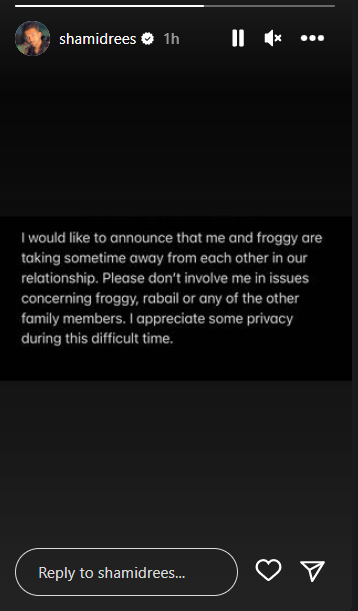
Sham is a Canadian based YouTuber, who has a following of 1.4 million people on Instagram, is widely-known for his entertaining content. His videos often feature his wife Sehar along with him.
The couple tied the knot a few years ago and is parents to baby Sierra who is two-years old. The duo welcomed another daughter on September 28, 2022. They named her Shanaya Idrees.
After the birth of his first daughter, Sham Idrees also introduced his fans to his daughter Dua from his previous marriage.
- Minister says power generation units are temporarily shut in winter at night.
- Says frequency variation in national grid triggered outage.
- Says ministry trying to restore power in next 12 hours.
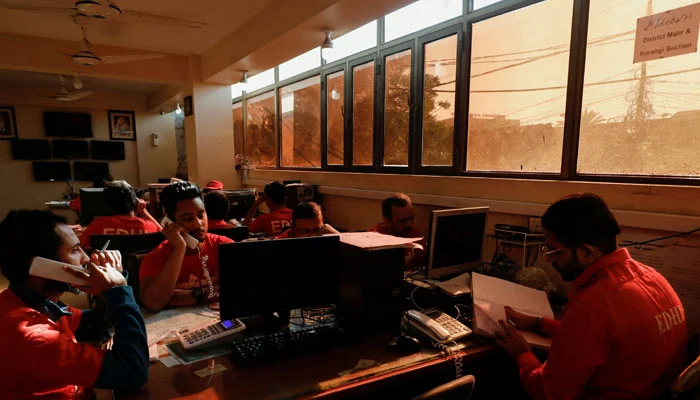
LAHORE/KARACHI/QUETTA/ISLAMABAD: A countrywide power breakdown, triggered by a “frequency variation” in the national grid early Monday morning, has left large parts of the country including Karachi, Lahore, Islamabad, Peshawar and Quetta without electricity.
Power Minister Khurrum Dastagir, while talking to Geo News, said that the power generation units are temporarily shut down in winter at night as an economic measure to save fuel costs.
“When the systems were turned on at 7:30am this morning one by one, frequency variation was reported in the southern part of the country between Jamshoro and Dadu. There was a fluctuation in voltage and power generating units were shut down one by one due to cascading impact. This is not a major crisis,” said the federal minister as the country plunged into darkness for the second time in four months.
The minister said that his ministry has started restoring some grid stations in Tarbela and Warsak.
“Peshawar Electric Supply Company (PESCO) and some grids of Islamabad Electric Supply Company (IESCO) have already been restored,” claimed the minister.
Talking about the breakdown in Karachi, the minister said that the matter in the port city is complicated as it has a complete electric supply system.
“We provide K-Electric about 1,000-1,100 megawatts routinely, however, it will be restored within a few hours. It is not certain how long will it take to sort this issue. However, my target is to restore electricity in the country in the next 12 hours,” said the minister.
Before the energy ministry’s announcement, different power distribution companies had confirmed the breakdown.
According to Quetta Electric Supply Company (QESCO), the two transmission lines have tripped leaving 22 districts of Balochistan, including Quetta without power.
Karachi power update
Meanwhile, K-Electric spokesperson Imran Rana said that at approximately 7:34am today, the national grid experienced a loss of frequency, affecting the power supply to multiple cities across Pakistan
“This has also cascaded to KE’s network affecting power supply to Karachi,” Rana said, adding the KE’s network is safe and protected.
“Our teams are actively monitoring the situation and enabling restoration efforts.”
An IESCO spokesperson said that its 117 grid stations were without electricity.
Meanwhile, PESCO also confirmed the outage in areas where it supplies electricity.
This is the second time within four months that a country was hit by a major power breakdown.
NEPRA takes notice
The National Electric Power Regulatory Authority (NEPRA), in a statement, said that it has taken “serious notice” of the power outage and directed the National Transmission & Despatch Company (NTDC) to submit a “detailed report”.
The statement also said that the regulator has previously imposed fines on similar outages in the 2021 and 2022. It also shared that NEPRA has consistently issued directives and recommendations on tackling such events in future.
Previous breakdown
In October of last year, Karachi, Hyderabad, Sukkur, Quetta, Multan, and Faisalabad were hit by a power outage.
At that time, the power minister said that nearly 8,000 megawatts of power went offline.
Back then, Dastagir had said that the simultaneous faults in two power lines, which had triggered the breakdown, at the same time was concerning for the government. He had also announced that an in-depth inquiry was ordered and promised action.
A timeline of power breakdowns in Pakistan
The country’s generation and distribution network has suffered eight major power breakdowns during the last nine years.
In 2014 and 2017, nationwide blackouts were caused by a fault in Tarbela Power Station while fog, frequency variation and the Guddu Power Plant fault were blamed for breakdowns in 2015, 2018, 2019, 2021, 2022 and 2023.
Every time the party in power announced to conduct a comprehensive probe and vowed to rectify the issues but nothing has happened despite multiple inquiries.


Supreme Court annuls trials of civilians in military courts

Sea conditions ‘very high’ as Cyclone Tej moves towards northwestward

IMF condition: ECC set to green light gas tariff hike today

Barwaan Khiladi: Kinza Hashmi discusses her role as Alia

Snap launches tools for parents to monitor teens’ contacts

WATCH: Pakistani traveller deported from Dubai for damaging plane mid-air

Learn First | How to Create Amazon Seller Account in Pakistan – Step by Step

Sajjad Jani Funny Mushaira | Funny Poetry On Cars🚗 | Funny Videos | Sajjad Jani Official Team
