- President being threatened with Article 6, lawyer says.
- Political parties fail to reach consensus over polls date.
- Decision to be announced at around 11:30am tomorrow.
- Ruling alliance withdraws plea seeking full court bench.
- President to withdraw advice regarding KP polls date.
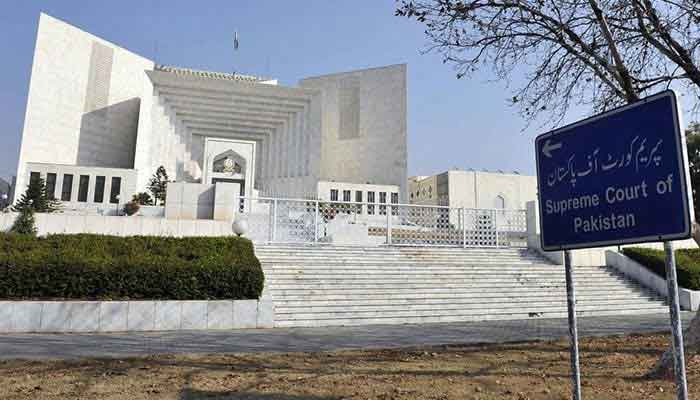
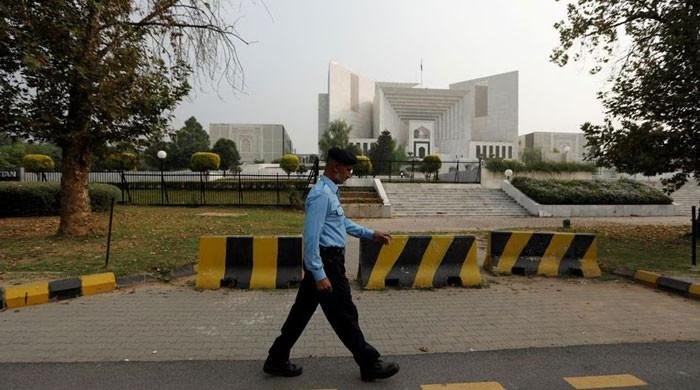
ISLAMABAD: The Supreme Court of Pakistan Tuesday reserved the verdict in the suo motu notice taken over the election date of Khyber Pakhtunkhwa (KP) and Punjab, with the decision set to be announced tomorrow (Wednesday) at around 11:30am.
A five-member bench headed by Chief Justice Umar Ata Bandial and comprising Justice Munib Akhtar, Justice Muhammad Ali Mazhar, Justice Mansoor Ali Shah, and Justice Jamal Khan Mandokhail conducted the hearings for two consecutive days — from Monday to Tuesday.
“I would like to thank all the lawyers who have assisted us throughout the hearings. I cannot say when will we be back [to announce the verdict],” the CJP said after the parties involved in the case wrapped up their arguments. Although the verdict was expected today, the CJP’s secretary said that the decision will be unveiled tomorrow.
The top court had also earlier today asked the political parties — the Pakistan Tehreek-e-Insaf (PTI) and the ruling alliance — to agree upon a mutual date for the elections, but they could not reach a consensus. The Pakistan Muslim League-Nawaz’s (PML-N) lawyer asked the court to continue the proceedings as the coalition partners needed more time to consult with each other.
The SC had taken the suo motu notice of an apparent delay in the elections of the two assemblies, on February 23, following President Arif Alvi’s announcement of the date of polls, a move that drew strong criticism from the government
As per the CJP, the suo motu notice had been taken to assess who was eligible to issue the date for polls and who had the constitutional responsibility of conducting elections and when.
A nine-member larger bench was constituted initially to hear the case but the bench was reconstituted after four judges — Justice Ijaz Ul Ahsan, Justice Sayyed Mazahar Ali Akbar Naqvi, Justice Athar Minallah and Justice Yahya Afridi — of the bench recused themselves.
Meanwhile, the ruling alliance — PML-N, Pakistan Peoples Party, and the Jamiat Ulema-e-Islam (JUI-F) — also withdrew their plea for the formation seeking a full court bench after the reconstitution of the bench hearing the case.
‘Can president or governor give election date on their own?’
At the outset of the hearing today, Attorney General for Pakistan Shehzad Ata Elahi informed the court that he was ready to give arguments.
He also raised an objection to the Supreme Court Bar Association President Abid Zuberi, saying that his name had been removed from the judicial order.
At this, CJP Bandial said that the court sees the SCBA as an institution. “What is written in the court is not part of a judicial order. It becomes an order when the judges sign it,” he remarked.
After this, Zuberi started his arguments.
“Supreme Court has declared it in the past that the elections should be held in 90 days,” Zuberi stated. At this, Justice Mandokhail remarked that the presidents and governors were bound to follow the Cabinet’s advice as per the Constitution.
“Can the president or governors give the election date on their own,” he inquired. Meanwhile, CJP Bandial remarked that the governor wasn’t constitutionally bound to follow anyone’s advice regarding the appointment of a caretaker government or deciding the election date.
While Justice Mazhar added that “no one’s advice is needed where there is discretion.” Moving on, the CJP asked that who would issue the notification for the assembly dissolution.
Responding to the question, Zuberi said that the notification for the dissolution of the Punjab Assembly had been issued by the law secretary.
’90-day period starts after assembly dissolution’
At this point, Justice Akhtar remarked that the 90-day period starts right after the assembly has been dissolved.
Meanwhile, Justice Shah inquired if the caretaker chief minister could advise the governor on the election date.
To this, Zuberi said that the caretaker setup and the election date are announced simultaneously. Justice Shah asked whether the governor could reject the caretaker government’s advice.
At this, Zuberi replied that the caretaker setup’s job was to look after government affairs instead of giving a date for the polls, which is the governor’s prerogative.
While referring to the Saifullah case, Zuberi said that the 12-member bench, in that case, had declared the election process a must.
At this, Justice Mandokhail remarked that Article 48 of the Constitution states that every act and step taken by the president would be on the government’s advice.
CJP Bandial seconded Justice Mandokhail’s remark, saying that the deciding a date for the polls would be based on the advice under Article 48. While Justice Akhtar remarked that the caretaker setup is appointed after seven days after the assembly’s dissolution.
“Harmony among different clauses of the Constitution is necessary,” he added. Meanwhile, Justice Mazhar remarked that in Punjab’s case, the ministry of law had issued the notification, not the governor.
Justice Mandokhail said that the government can still tell the governor to conduct elections, as per the Constitution. Justice Shah wondered how could the governor refuse to conduct elections if he receives the government’s advice regarding the poll date.
Moving on, Zuberi stated that the caretaker setup was established in Punjab on January 22. Justice Mazhar remarked: “A basic question is that the governor is saying that he didn’t dissolve the assembly.”
Zuberi shared that as per Article 105(3) mentions the process of giving an election date. Justice Mandokhail said that the government is not bound to give a date for polls.
Zuberi then complained that the date for the polls has not been announced even after so many days.
‘Holding polls within 90 days is spirit of Constitution’
To this, CJP Bandial asked Zuberi if he was arguing that the government wasn’t fulfilling its constitutional duty.
“Holding elections within 90 days is the spirit of the Constitution,” he observed, adding that the court would ask the AGP to assist it on the legal points.
Meanwhile, Zuberi contended that the president would announce a date for the polls if the duration of the assembly ends.
“I contend that fixing the date of polls is the prerogative of the president,” he added.
At this, Justice Mazhar remarked that a 52-day margin would be kept whenever the governor gives the date.
President’s power not stated clearly: judge
Meanwhile, Justice Mandokhail remarked: “President’s powers have not been stated directly by the Constitution.”
“The action will be taken as per the law if the Constitution doesn’t have the powers,” he said, adding that the laws are based on the Constitution.
Meanwhile, Justice Shah inquired under which law the president was “writing the letters”.
At this, Zuberi said that the president had written the letters for consultations.
To this, the judge replied that the Constitution does not state anywhere about holding consultations.
“If we assume that the law allows the president, even then he is bound to [follow] the advice,” Justice Mandokhail remarked.
Meanwhile, Justice Shah said that the caretaker government can also ask for deciding a date.
At this, CJP Bandial remarked that the court would decide if the president needed consultation or not, after hearing the other parties in the case.
Zuberi argued that the governor wasn’t bound to follow the advice for announcing the date of the election. The same authority as the governor has been given to the president, he added.
“The president either is not bound to [follow] the advice,” Zuberi said while wrapping up his arguments.
Justice Shah remarked that the governor was bound to follow if he was advised to decide an election date.
Elections should be held in 90 days: AGP
After this, the AGP Shehzad Ata Elahi started his arguments.
“The president can give a date for the election only in case of the dissolution of the National Assembly,” he said. He added that the other scenario in which the president can give dates for elections is when polls are being conducted countrywide.
At this, CJP Bandial remarked that the president’s powers to make a decision at the discretion and on advice had a difference.
AGP Elahi then argued that the ECP wouldn’t follow the orders if the governor tells it to hold the election a day after the assembly’s dissolution.
At this, Justice Akhtar remarked that the governor had to keep the Election Act in view as well.
The AGP remarked that the elections should be held in 90 days and the duration shouldn’t be prolonged.
Justice Shah asked if the ECP could delay the election if the date is announced by the governor.
At this, the AGP replied that the electoral body can ask for holding elections in 89 days if the governor orders conducting election on the 85th day after the dissolution of the assembly.
On this, CJP Bandial remarked that it was the reason that the governor has been bound to hold consultation with the ECP.
“Whether it is the president or the governor, everyone is bound by the Constitution and law,” he said
To this, Justice Mazhar suggested holding a consultation between the governor and ECP and giving a date tomorrow.
At this point, the court adjourned the hearing for half an hour.
President cannot announce date of elections: AGP
When the hearing reconvened, the AGP continued his arguments and said that the Constitution cannot be interpreted through parliamentary legislation.
“The Constitution is supreme and it doesn’t allow the president to announce a date of the election,” he added.
He said that the Lahore High Court had clearly said that conducting the elections and announcing a date for it was ECP’s authority.
He further stated that the elections were a “subject” for the Centre.
At this, Justice Akhtar said that the ECP has to decide a date for the election and the governor has to announce it.
Justice Mandokhail interjected and wondered if everything was clear then what was the fight about?
Meanwhile, CJP Bandial observed that the hearing of intra-court appeals in the LHC was being adjourned for 14 days. He asked why was such an important constitutional issue was being deferred for long periods.
Moreover, the CJP also inquired under which clause of the Constitution, the ECP has been given the power to decide the poll date.
On this, Justice Mazhar said that the ECP’s authority starts after the announcement of the election date, as per the Constitution.
The CJP then remarked that the president had some democratic and some non-democratic powers over the date.
At this, Justice Mazhar asked why don’t abolish Section 57 if the president is not authorised to give the election date. He asked if anyone had challenged Section 57 for being contradictory to the Constitution.
The judge also asked for the AGP’s opinion that who had the authority to give the date.
ECP has authority to give election date: AGP
Responding to the query, AGP Elahi said that the ECP had the authority to give a date for the election.
In response to AGP’s comment, Justice Mandokhail said that no consultation was needed if the ECP had to announce the date.
However, Justice Akhtar asked where would the governor and president’s role go if that was the case.
“Is the president’s role of a newscaster that he makes the announcement,” he said, adding that the ECP should use its website if it was just about making an announcement.
At this, the CJP remarked that ECP’s role is important under any circumstances.
“According to you president’s role is central while the other side says it is consultative,” CJP Bandial said while addressing Justice Akhtar.
On this, Justice Akhtar asked if the duration of the election campaign could be shortened.
Responding to the question, ECP’s lawyer maintained that the printing process of the ballot papers required time. He, however, said that the duration of the election campaign can be shortened up to two weeks.
Justice Akhtar remarked that implementing the constitution was more important.
On this point, AGP Elahi contended that wouldn’t the 1988’s election become controversial if elections have to be conducted in 90 days?
He said that the 2008 polls were also held after the designated period.
At this, CJP reminded the AGP that in 2008 there was a big tragedy. The CJP was referring to the murder of former prime minister Benazir Bhutto.
At this, Justice Mandokhail reiterated the question of who will give the date.
“Had the matter of fixing a date been clarified in the law, we wouldn’t be standing at this point today,” he remarked.
‘Article 254 to be where it is valid’: CJP Bandial
At this, CJP Bandial remarked that the court would apply Article 254 where it is valid.
Justice Mazhar added that ECP had recommended a date to the governor.
On the other hand, Justice Mandokhail inquired whether the caretaker cabinet can send a summary to the governor.
At this, the AGP replied in negation.
While Justice Mazhar asked how long should the president wait if the prime minister does not send him the advice.
On this point, Justice Mandokhail remarked that the Parliament could have made a law and given the responsibility to someone.
The AGP told the court that if laws are passed today then the Parliament is mocked that it is incomplete. He also reiterated that the ECP should give the date of polls as the 90 days period is close to completion.
“If the dictation on the election date has to come from somewhere else then the ECP can refuse to fulfil other responsibilities as well,” he said while completing his arguments.
The AGP completed his arguments on this point and the ECP’s lawyer started presenting the electoral body’s point of view.
‘ECP can give Senate, presidential, and by-elections dates only’
While starting the arguments, ECP’s lawyer Shehryar Swati said that the electoral body had to work under the Constitution.
He said that the Punjab and KP elections were being discussed in the case while the ECP can give the dates for Senate, presidential and by-elections.
The lawyer stressed that they have been maintaining the stance that governor has to give the election date.
At this, CJP Bandial remarked that the chief minister’s advice to dissolve the assembly has a different efficacy as even if the governor doesn’t dissolve the assembly, the order has to be followed.
At this, Justice Mandokhail asked if the ECP’s lawyer meant the governor would give a date for whether he dissolves the assembly or not.
The lawyer told the bench that the governor states that he did not dissolve the assembly. He added that the ECP wrote to the governor to appoint a date from April 9 to 13.
At this, CJP Bandial asked if the governor issues the election date unilaterally or after consultation. He also wondered if the governor is aware of the ECP’s schedule.
Swati then said that the consultation between ECP and the governor wasn’t required.
At this, Justice Mazhar remarked that the LHC had directed the governor to hold a consultation and instead the governor filed an intra-court appeal.
The ECP lawyer told the bench that they had held a meeting with the governor on LHC’s directives.
CJP asks about KP polls
On this point, CJP inquired if the ECP had spoken to the KP governor about a date for the polls.
The ECP lawyer said that they had written letters to the governor.
“All the institutions are bound to assist the ECP during elections,” remarked Justice Mazhar.
While informing the court about the consultation with the KP governor, the ECP’s lawyer said that the latter neither gave a date nor held any consultation despite reminders.
He said that the KP governor cited the peace and security situation in the province as the reason and asked the ECP to contact the agencies.
“According to Governor KP, the date should be fixed after consulting other institutions,” observed CJP Bandial. He added that it was the ECP’s responsibility to be active in election matters.
“ECP’s job was to complete its work and contact the governor again. Election Commission should not just write letters,” said CJP Bandial.
At this, the CJP directed ECP to announce a date for the elections in Punjab after consulting with other stakeholders including the governor.
The court then summoned the KP advocate general on the rostrum and asked what was the meaning of the governor’s letter.
At this KP advocate general maintained that the governor would be authorised to decide a date only if he dissolved the assembly, but in KP’s case, the assembly had been dissolved on the chief minister’s advice.
‘Only court can increase designated period for elections’: CJ
Later, the SC directed Pakistan Tehreek-e-Insaf leaders Shireen Mazari and Fawad Chaudhry to consult with party chairman, Imran Khan, and coalition partners’ lawyers to consult with their leaders and update the court by 4pm.
Meanwhile, Justice Shah told the parties to inform the court whether or not they can decide the date together.
“The court can only tell that who has to give the date,” he added.
Meanwhile, CJP Bandial remarked: “No constitutional body can increase the designated period for the elections except for the court.”
He said that Article 254 was for exempting the delay in elections and can be applied in case of natural disaster or war.
“The stability will not be achieved if the elections are not held on time,” the CJP observed.
‘Unconstitutional’
Once the hearing resumed, Naek told the bench that he has consulted with the PPP leadership, and they have informed him that it is not the job of the political parties to issue the date for elections.
PML-N’s lawyer, Mansoor Usman Awan, said that the coalition partners — including PPP and PML-N — have to hold consultations over the issue. He requested the court to continue proceedings and asked for more time.
Resuming his arguments, Naek said President Alvi had announced the date for elections without consulting Prime Minister Shehbaz Sharif, which is “unconstitutional”.
“He also did not consult the election commission.”
Justice Akhtar then said that if the assembly has completed its term, then who will advise the president? “It is important to hold elections within two months after an assembly has completed its term.”
Justice Akhtar said that the president can send the summary back after 14 days, however, this process of sending the summary back and forth will waste around 25 days.
He added that the president can also ask the prime minister to take a vote of confidence and does not need his advice for that.
Interjecting, Naek said that the president sent announced the election date without consulting the prime minister and stressed that it was against the Constitution.
CJP Bandial said that in the current circumstances, it was crucial to hold elections within 90 days, adding that Peshawar and Lahore’s high courts have delayed the issue as well.
The chief justice remarked that today was the second consecutive day that the top court was hearing the suo motu notice and noted that the SC would favour none, but the Constitution.
Naek told the CJP that the SC could ask the high courts to issue the cases at the earliest.
CJP Bandial then told Naek that the SC is holding hearings over the matter to resolve it and noted that despite being understaffed, the top court had wrapped up 24 big issues in a year.
Justice Akhtar then said that it is the president’s discretion and that he can announce the election date. He added that the supreme commander should gear up immediately after an assembly’s tenure has been completed.
‘Judicial activism’
Then the CJP said that the court is not favouring anyone and it was just following the Constitution, while Naek asked the chief justice again to tell the high courts for expediting the process.
The CJP told Naek that it was too late for that and that the top court took the suo motu notice to ensure that the Constitution is implemented.
“Nobody was worried when the assembly was dissolved on January 14. Farooq Naek sahib, did you hear the count? Mr Farooq Naek sahib, you are also right to point out that the courts should not interfere in political matters.”
The CJP also told Naek that in the last two years, the top court has taken very less — two to be exact — suo motu notices. “In the ongoing year, this is the first suo motu notice that we have taken and we are trying to determine who has the constitutional authority to announce the election date.”
Naek then told the bench that in line with the top court’s rules, whenever a petitioner moves the Supreme Court, they have to inform the SC whether their issues are pending in other courts or not.
“PTI did not tell the Supreme Court in its constitutional petition that their cases are pending in the high courts. I want to talk about something and then I’ll complete my arguments: Judicial activism that started in 2007 is now turning into judicial restraint.”
KP governor’s ‘right’
During the hearing, President Alvi’s lawyer Salman Akram Raja said that his client has decided to withdraw his notification for the general elections in KP as the province’s governor had dissolved the assembly — unlike Punjab, where the governor did not.
“The president has stated that it is the right of the governor to issue the election date,” Raja said, at which Justice Mazhar asked why he hasn’t taken the advice back yet.
“He will take it back soon,” Raja responded.
Raja conceded that the president went beyond his constitutional powers and that he did not have the right to announce the election date in KP.
“So, is the president guilty of contempt of court?” Justice Shah asked, to which Raja said that “no, he is not a party in the ongoing cases in the high courts.”
The lawyer added that the president had summoned the ECP officials for consultation, but the commission refused.
He added that President Alvi gave the election date according to the constitution and law. “Elections should take place within 90 days by all means.”
Raja also maintained that the court has jurisdiction to take suo motu notice and hear petitions.
He informed the court that the president is being threatened with action under Article 6. “The cabinet has warned the president of action against him through Article 6.”
Responding to which Justice Mandokhail said: “They don’t apply Article 6 where it [actually] applies.”
Raja insisted that no one is obeying the president’s order, which is why they are supporting the court’s proceedings.