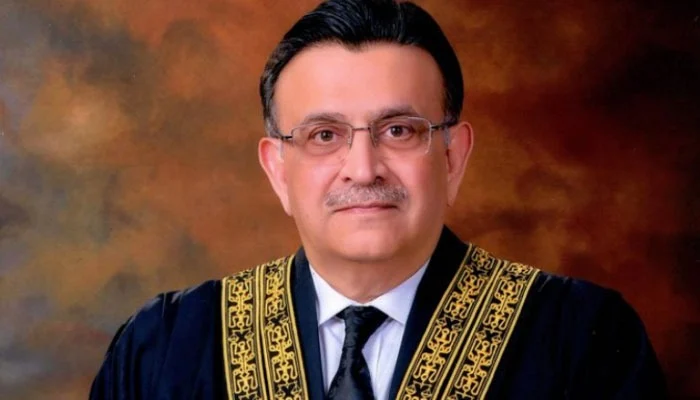
ISLAMABAD: As the Supreme Court of Pakistan (SC) Monday resumed the hearing for the case of the Punjab chief minister’s election, Chief Justice of Pakistan Umar Ata Bandial said that the court needs more legal clarification regarding the formation of a full bench to issue a verdict on the case.
The CJP also said that he was unsure whether the decision on the said ruling will be made today. Meanwhile, the court also accepted the petition filed by PML-Q President Chaudhry Shujaat Hussain and the PPP to become a party in the case.
During the hearing, Deputy Speaker Mazari’s lawyer, Irfan Qadir said he was instructed to speak regarding the formation of the full court only; therefore, he needed time to take instructions from his client.
Meanwhile, Hamza Shahbaz’s counsellor Mansoor Awan sought time to take instructions for arguments on merit.
Justice Ijazul Ahsan reiterated that the decision to form a full court will be made on merit. Meanwhile, Law Minister Azam Nazeer Tarrar asserted that there was enough clarification in this regard.
Advocate Qadir said he was instructed to speak regarding the full court formation only; therefore, he needs time to take instructions from his client.
Meanwhile, Hamza Shahbaz’s counsellor Mansoor Awan sought time to take instructions for arguments on merit.
Justice Ahsan reiterated that the decision to form a full court will be taken on merit; meanwhile, Law Minister Azam Nazeer Tarrar asserted that there is enough clarification in this regard.
Tarrar added that if the review petition is approved that there will be no need for a run-off election.
During the hearing, CJP Bandial said that the case regarding the National Reconciliation Ordinance (NRO) was heard by a full court because it was a “constitutional matter”.
“We have sent the prime minister home with five judges at that time you [coalition parties] were celebrating and now you are standing against this,” the chief justice said, adding that if this matter crosses the limit, then a full court will be formed.
Presenting his arguments, advocate Qadir added that when allegations are levelled against the judges that similar bench is formed repeatedly then these charges can be rejected by the formation of a full court.
“There is no objection on the neutrality of the current three-member bench; however, to remove any ambiguities, a full court needs to be formed,” the deputy speaker’s counsellor said.
Earlier in the day, the SC had reserved the verdict on the petitions filed by Chief Minister Punjab Hamza Shahbaz and other bar associations — seeking the formation of a full court for the hearing of the case — after it heard arguments from party lawyers.
However, the CJP gave a break of an hour-and-a-half on the petition of Elahi, which challenged Punjab Assembly Deputy Speaker Dost Muhammad Mazari’s ruling in the CM elections.
Last week, the top court asked CM Punjab to retain his position as a “trustee” chief minister till Monday (today), adding that he would have limited powers throughout this period. The court also noted that if Hamza appointed someone against merit during this time, such appointments would be considered null and void.
A three-member bench — headed by Chief Justice Umar Ata Bandial, and comprising Justice Ahsan and Justice Munib Akhtar — is holding the hearing at the Supreme Court’s room number 1.
Mazari had dismissed PML-Q’s 10 votes after party head Chaudhry Shujaat asked them to vote in favour of Hamza, but they did not follow his instructions.
But the PTI and Elahi did not accept this and approached the top court.
Today’s hearing
At the outset of today’s hearing, Advocate Latif Afridi — the former head of the Supreme Court Bar Association (SCBA) — came to the rostrum and pleaded to the court on behalf of lawyers’ bodies, saying the system is facing dangers as there are numerous challenges.
“The review petition in the Article 63(A) case should be fixed before a full court,” Afridi said, as he noted that the political crisis in the country was deepening over time.
At this, CJP Bandial said that he was honoured that the former SCBA chief had put the matter before him, but noted that the court would take a decision after hearing all parties in the case.
CJP Bandial said that he did not want to issue a one-sided order and neither would he arrive at a decision under the advice of 10 former presidents.
“We need to hear the other side of the story as well,” he said. At this, Afridi said that a full bench should be constituted and the available judges should be included.
Moving on, PPP lawyer Farooq H Naik said that he has requested to become a party in the case, at which the CJP told him that let the initial matters be wrapped up first.
“We will hear you, but let the proceedings move in line with the order. Please sit, I hope that your seat will be vacant,” the CJP told Naik.
In response, Naik told him that “seats come and go”.
During the proceedings, SCBA President Ahsan Bhoon said that he could not “imagine” pressurising the court, but noted that the review petition on Article 63A should be heard.
“What’s the hurry Bhoon sahab, let us hear this case first,” CJP said.
Barrister Ali Zafar — who is representing Elahi in the case — said that he has also remained the president of the bar. “The bar presidents should not be involved in such matters.”
Qadir, when he came to the rostrum, too said that since there are several confusions over the matter, a full bench should hear the case.
‘Extremely confused’
Then, Mazari’s counsel read out the court’s order issued on July 23. At this, the CJP asked the lawyer how the deputy speaker arrived at the conclusion that the court’s order on Article 63 (A) gives the impression that it speaks about the party head.
“This question is for you [and] that is why a special bench has been formed. The question here is what happens when the party head and the parliamentary party’s decisions differ?”
Qadir said that it was not his job to define what questions arise here, but it was the court’s task. At this, the CJP asked him to read out Article 63 (A).
The CJP then said that the article mentions the party head and the parliamentary party.
“I am extremely confused as to what the question is here? I cannot understand what’s the question?” he asked.
The CJP then said that maybe the lawyer was having trouble hearing the judges and warned him that he would be asked to sit at his seat if he cuts off any judge while they are speaking.
Justice Ahsan asked if the same person can issue declarations and instruct a parliamentary party at the same time. At this, Qadir said that the political parties’ rights have been mentioned in the constitution.
Justice Akhtar then said that the deputy speaker issued the directions — during the Punjab CM election on July 22 — under the SC’s ruling in the Article 63(A) case.
“There is no confusion in this case anymore, let someone else speak now,” Justice Akhtar added.
‘Parliamentary party has the right to issue directions’
Justice Ahsan then started speaking with Hamza’s lawyer, Mansoor Usman Awan and asked him specifically which paragraph did the deputy speaker refer to while issuing the directives.
The lawyer told him that the only point here is that any vote cast against the party policy should be dismissed.
Justice Ahsan asked whether the party head could be the leader of the parliamentary party.
At this, Awan said that in previous orders of the apex court, it is mentioned that the party head can give directions to the party.
He said that Justice Azmat Saeed’s order has mentioned that the party head takes all the decisions.
But Justice Akhtar said that there are two different policies while voting on the directions of the party policy.
He added that previously, there was confusion over the party head’s functions, but after amendments in Article 63 (A), the “parliamentary party has the right to issue directions”.
The lawyer then told the court that the deputy speaker gave his ruling based on paragraph three of the SC’s order on Article 63 (A).
Shujaat’s letter received ‘much before’ session
Upon the court’s query about Chaudhry Shujaat’s letter to his party MPs, Law Minister Azam Nazeer Tarrar said that the directions were given to members “much before” the assembly session.
During the arguments, the court stopped Hamza’s counsel Awan from taking directions from the federal minister.
“You are the chief minister’s lawyer, how can you take guidance from the law minister?” Justice Munib asked.
Continuing his arguments, Awan said that PTI Chairman Imran Khan gave directions to his MPs and the Election Commission de-seated the dissents lawmakers on the basis of these instructions.
He also presented Khan’s letter before the bench.
‘My party, my letter’
In his arguments before the SC bench, Chaudhry Shujaat’s counsel Salahuddin confirmed that he [Shujaat] wrote a letter to his party lawmakers.
“The party is mine and the letter is also mine,” Salahuddin quoted Shujaat as saying.
The CJP asked the lawyer to limit his arguments to the formation of a full bench as the PML-Q president has not been made a party in the case.
“I want a full court to be formed,” Salahuddin said.
The deputy speaker also relied on Article 63(A), said Barrister Zafar. “The court has already given an opinion on Article 63(A) after detailed hearings and its judicial interpretation is very clear and unambiguous.”
“The party leader has to give a declaration according to the instructions of the parliamentary party,” said Elahi’s lawyer, adding that “accepting the directions given by the parliamentary party is democratic.
The barrister said that those having different opinions in a party meeting are bound by the decision.
CJP Bandial stopped Advocate Zafar from giving judicial notices. “We are not listening to you about the merits of the case, tell us whether a full court should be formed or not?” asked the CJP.
To this, Barrister Zafar said that it was the chief justice’s choice to form a full court. “Should the full court stop all the other cases to hear a single case? The full court has been formed only in three or four cases in the last 25 years,” he added.
He said that the request to form a full court has been rejected in 15 cases in the past years.
The chief justice said that the court reduced the burden of pending cases by continuous hearings on routine benches.
No objection on full court: PTI
Speaking to journalists outside the courtroom, PTI leader Fawad Chauhdry said the party has no objection to the demand for the formation of a full bench.
“If [the] chief justice himself decides to form a full bench then he can,” Fawad said, adding that it would not be acceptable if formed on the coalition partners’ demand.
Ban imposed on entry of political leaders in SC
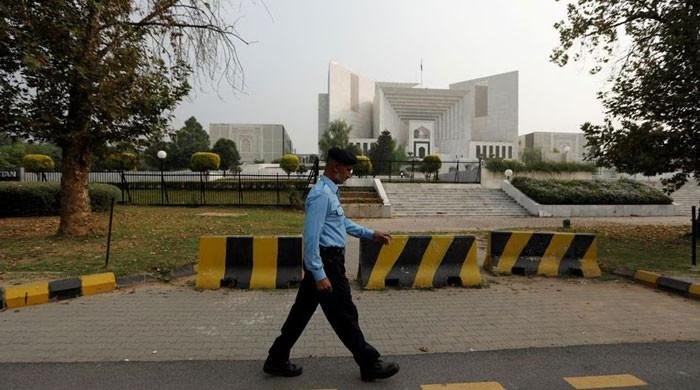
The entry of all political leaders to the Supreme Court has been banned for the hearing on the case related to the election of the Punjab chief minister.
Strict security arrangements are in place in and around the apex court. A police force is stationed outside courtroom number one, while registered beat reporters from the media are allowed to enter courtroom number one.
Apart from this, only parties to the case will be allowed to enter courtroom number one. Court proceedings can be heard through speakers in rooms six and seven of the SC.
Hamza submits plea to form full court bench
Earlier today, Punjab Chief Minister Hamza Shahbaz filed a petition in the apex court to constitute a full court on the issue of the election of a CM for Punjab.
In the petition, it has been stated that the ruling given by Deputy Speaker Dost Mohammad Mazari on July 22 is valid, while Chaudhry Shujaat Hussain’s letter to his lawmakers is in accordance with the Constitution and the law.
The petition further stated that the Election Commission of Pakistan had upheld the instructions given in the letter written by Imran Khan against the defecting members.
Hamza requested in the plea to hear the appeals of the defected members against the ECP.
Govt sticks to full court hearing ask
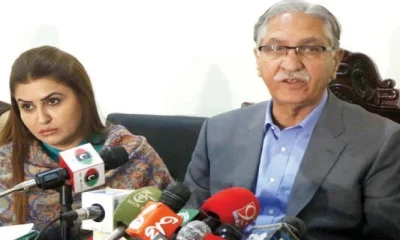
The coalition government rulers held a press conference hours before the hearing started and demanded that a full court hear the case, not three judges.
PML-N Vice President Maryam Nawaz said that “bench-fixing” is a crime similar to “match-fixing” and suo motu notice should be taken over it as she criticised a “specific” anti-PML-N bench being constituted for one-sided decisions.
PPP chairperson Bilawal Bhutto, too, reiterated that the coalition government only has one demand: the formation of a full bench to hear the case related to the Punjab CM’s election.
“This cannot happen that three people decide the fate of this country. Three people cannot decide on whether this country will run on a democratic, elected or selective system,” he said.